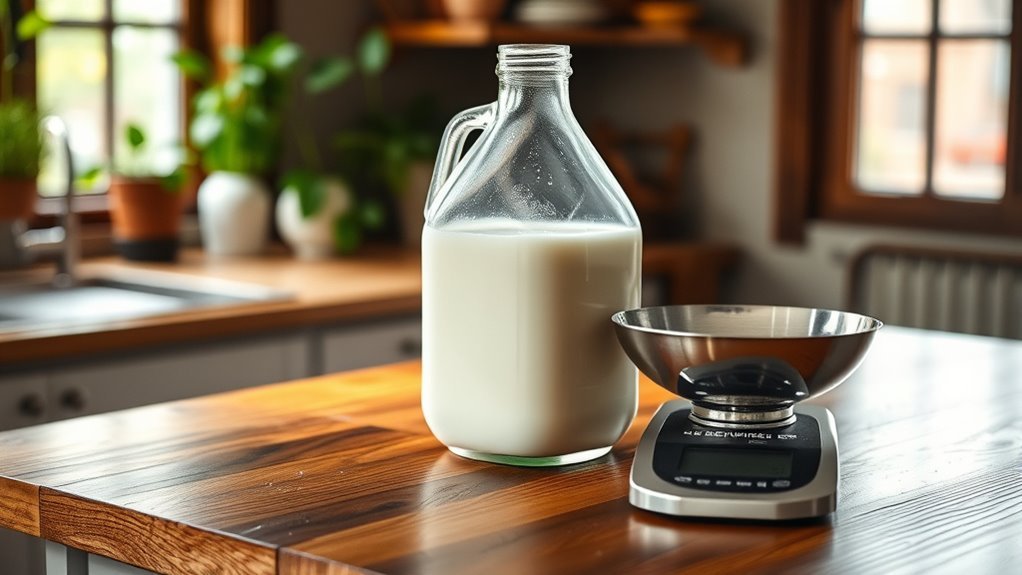
How Many Pounds Does a Gallon of Milk Weigh? Exact Answer & Facts
If you’ve ever wondered how many pounds does a gallon of milk weigh, you’re not alone. Many people assume it weighs exactly the same as a gallon of water. However, factors like fat content and measurement systems actually change its weight.
Understanding these nuances can make a surprising difference, especially if you work with dairy or just want to grasp what’s in your fridge. Let’s explore what really determines a gallon of milk’s weight.
Understanding the Weight of a Gallon of Milk

Although it may seem straightforward, understanding the weight of a gallon of milk requires considering its density and composition.
You might expect it to weigh the same as water, but a gallon of milk weighs about 8.6 pounds (3.9 kg) in the United States, slightly heavier than water’s 8.35 pounds.
This difference comes from milk’s density, roughly 1.03 g/cm³, which is a bit higher due to the fats, proteins, and minerals it contains.
While different types of milk, like skim or whole, vary in fat content, these changes only minimally affect the overall weight.
Also, keep in mind that the weight of a gallon of milk can vary slightly depending on the country and measurement standards used.
Factors Influencing Milk Weight Variations

Because milk contains varying amounts of fat, protein, and other nutrients, its weight can differ slightly from one type to another.
You’ll notice that the density of milk changes with its fat content, affecting the weight of a gallon.
For example, whole milk has a lower density than skim milk, so a gallon of skim milk weighs a bit more.
Compared to water, milk is denser due to fats, proteins, lactose, and minerals, which add to its overall weight.
Even small shifts in fat content can cause about a 10-gram difference per gallon.
Understanding these factors helps you see why the weight of a gallon of milk isn’t fixed but varies depending on its composition and density.
Comparing Milk Weight Across Different Countries

When you compare a gallon of milk across countries, you’ll find notable differences in weight due to how gallons are defined. In the US, a gallon of milk weighs about 8.6 pounds, while in the UK and Canada, it’s closer to 10.3 pounds.
This difference stems from the US gallon being smaller than the imperial gallon. *Fascinatingly*, a gallon of water weighs less in the US system than in the imperial one, which also affects milk weight. Here’s a quick comparison:
| Country | Gallon Type | Gallon Volume (liters) | Milk Weight (lbs) | Gallon of Water Weighs (lbs) |
|---|---|---|---|---|
| US | US gallon | 3.785 | 8.6 | 8.34 |
| UK | Imperial gallon | 4.546 | 10.3 | 10.0 |
| Canada | Imperial gallon | 4.546 | 10.3 | 10.0 |
Understanding this helps with recipes and trade.
How Milk Fat Content Affects Its Weight
If you’ve ever compared whole milk to skim milk, you might notice a slight difference in their weight per gallon. This happens because milk contains varying amounts of fat, which affects its overall density and weight.
Whole milk, with higher fat content, weighs about 8.7 pounds per gallon, while skim milk, which has most of the fat removed, weighs around 8.6 pounds per gallon.
Whole milk weighs about 8.7 pounds per gallon, slightly more than skim milk at 8.6 pounds.
Fat has a lower density than water, so milk with more fat is slightly less dense, but the presence of milk fats, proteins, and other solids in whole milk increases its weight just a bit.
Although these differences are minimal, they do cause whole milk to weigh marginally more than skim or reduced-fat varieties.
Difference Between Milk and Water Weight
Although milk is mostly water, it weighs more per gallon due to the additional solids it contains. You might assume milk and water weigh the same since milk is mostly water, but milk’s fats, proteins, and minerals add extra weight.
A gallon of water weighs about 8.35 pounds, whereas a gallon of milk weighs around 8.6 pounds. This difference comes from milk’s higher density, ranging from 1.026 to 1.034 g/cm³, compared to water’s density of 1.000 g/cm³.
Here’s a quick comparison to help you visualize:
| Substance | Weight (per gallon) | Density (g/cm³) |
|---|---|---|
| Water | 8.35 lbs | 1.000 |
| Milk | 8.6 lbs | 1.026 – 1.034 |
Milk’s extra solids make it heavier than water despite its high water content.
Historical Perspective on Milk Measurement
Understanding the weight differences between milk and water gives you a glimpse into how milk’s composition affects its measurement.
Historically, the question of how much does a gallon of milk weigh varied globally.
In the US, a gallon of whole milk weighs about 8.6 pounds, while in the UK and Canada, it weighs closer to 10.3 pounds due to their larger Imperial gallon.
Even though milk weighs more than water, these differences stem from measurement standards rather than milk’s density alone.
Before refrigerated trucks, farmers used 10-gallon milk cans to transport fresh milk, making milk weight vital for pricing and logistics. This entry was posted to highlight how milk weight and volume have evolved, reflecting diverse systems across the world and the importance of accurate milk weight measurement historically.
Practical Applications of Knowing Milk Weight
Since milk’s weight directly impacts many everyday tasks, knowing how much a gallon weighs, about 8.6 pounds, helps you measure ingredients accurately, calculate nutrition, and manage portions effectively.
When cooking or baking, precise milk weight ensures your recipes turn out just right.
If you’re tracking your diet, understanding milk’s weight aids in accurate calorie and nutrient counting.
For farmers and suppliers, this knowledge helps determine shipping costs and storage needs, saving money and optimizing space.
Dairy processors rely on exact milk weight to maintain product consistency across batches.
Even in commercial settings, knowing milk’s weight lets you estimate total volume when handling large quantities.
Whether you’re a consumer or professional, having a clear idea of milk weight streamlines your daily tasks and decisions related to milk use.
Tools and Methods for Calculating Milk Weight
When you need to calculate the weight of a gallon of milk, you can start by converting the volume from gallons to cubic centimeters. Then, use milk’s average density to find its weight in grams.
Since 1 gallon equals about 3785.41 cm³ and milk’s density averages 1.03 g/cm³, multiply these values to get the weight in grams.
Next, convert grams to pounds by dividing by 453.59237. Alternatively, you can use the shortcut formula: weight (lbs) = volume (gallons) × 8.6, which provides a quick estimate based on average milk weight per gallon.
For more accuracy, consider variations in milk density caused by fat content and temperature, and use precise density values accordingly.
The Role of Milk Weight in Dairy Farming
Because milk weight directly impacts farm operations, you’ll find it essential for accurate record-keeping and billing. Knowing that a gallon of milk weighs about 8.6 pounds helps you track total production accurately and assess each cow’s yield, which is critical for measuring productivity and profitability.
You can manage transportation more efficiently by calculating the weight you need to move, ensuring logistics run smoothly.
Since milk’s fat content can alter its weight, you’ll use this information to adjust pricing strategies and maintain quality control.
Plus, weighing milk precisely guarantees proper storage and handling, helping you comply with industry standards.
In short, understanding milk weight is key to running a dairy farm effectively and making informed decisions every day.

Common Misconceptions About Milk Weight
Although many people think a gallon of milk weighs exactly 8 pounds like water, it actually weighs about 8.6 pounds. You might assume milk’s fat content makes it lighter, but higher fat slightly increases weight due to density.
Also, milk isn’t just fat; other components add weight, so it’s heavier than water. You may believe milk’s weight is the same everywhere, but it varies by location and measurement standards.
Finally, not all milk types weigh the same, as fat and nutrients cause small differences.
| Misconception | Reality |
|---|---|
| Milk weighs 8 pounds | Milk weighs about 8.6 pounds |
| More fat means lighter milk | More fat slightly increases weight |
| Milk weighs less than water | Milk weighs more than water overall |
| Milk weight is uniform globally | Weight varies by region and standards |
| All milk types weigh the same | Weight varies by milk type and content |
Frequently Asked Questions
Does a Gallon of Milk Weigh the Same as Water?
No, a gallon of milk doesn’t weigh the same as water. It’s heavier, about 8.6 pounds, because of fats, proteins, and minerals. Water weighs around 8.34 pounds per gallon.
How Much Does a 1 Gallon Jug of Milk Weigh?
A 1-gallon jug of milk weighs about 8.6 pounds in the US, but it can vary slightly depending on fat content or brand.
In the UK and Canada, it’s roughly 10.3 pounds due to measurement differences.
How Much Does a Farmer Get Paid for a Gallon of Milk?
You typically get around $1.40 to $2.00 per gallon of milk as a farmer, which is about 40-50% of the retail price.
Prices vary by region, season, and market conditions, so stay informed.
Does a Gallon of Water Weigh 10 Pounds?
You might think a gallon of water weighs 10 pounds, but it actually weighs about 8.34 pounds.
Conclusion
Think of a gallon of milk like a ship steering varied seas—its weight shifts with the currents of fat content and measurement systems. Just as a captain reads the stars to steer true, you can understand these factors to grasp milk’s true weight.
By knowing these subtle changes, you’ll navigate dairy decisions smoothly, avoiding the rough waters of misconception. Anchoring your knowledge firmly in fact helps you understand how many pounds does a gallon of milk weigh.