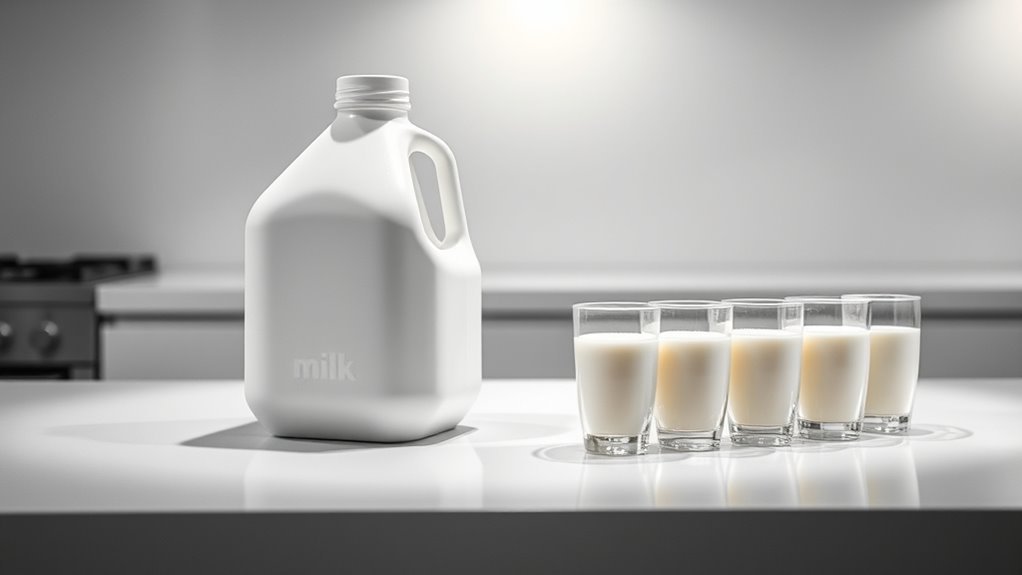
How Many Cups Are in a Half Gallon of Milk
You’ll find exactly 8 cups in a half gallon of milk since one gallon equals 16 cups. This is because a gallon holds 128 fluid ounces, and each cup is 8 fluid ounces, making conversions easy.
Whether you’re cooking or baking, knowing this helps you measure ingredients precisely and avoid mishaps. If you want to better understand how accurate milk measurements affect your recipes or learn useful measuring tips, there’s plenty more to explore.
Understanding the Gallon Measurement System

Although you might be familiar with gallons from everyday use, understanding the gallon measurement system helps you accurately convert volumes. A gallon is a unit of volume commonly used in the United States to measure liquids like milk, water, and fuel.
One gallon equals 128 fluid ounces, which is essential to know when you want to convert gallons into smaller units. The gallon is also divided into quarts, pints, and cups, making it easier to work with recipes or other measurements.
For example, there are 4 quarts in a gallon and 2 pints in each quart. Knowing these relationships allows you to break down a gallon into manageable parts, helping you measure or convert volumes precisely without guesswork.
The Standard Cup Measurement in Cooking

When you follow a recipe, knowing the standard cup measurement guarantees your ingredients are accurate and your dish turns out right. In the U.S., one standard cup equals 8 fluid ounces or about 237 milliliters.
This measurement is consistent across most recipes, making it easier for you to measure liquids like milk, water, or oil precisely. Using a proper measuring cup designed for liquids helps you avoid spills and ensures accuracy.
For dry ingredients, a dry measuring cup allows you to level off excess for exact amounts. Remember, standard cups differ from mugs or coffee cups, which vary in size.
Sticking to the standard cup measurement keeps your cooking reliable and your results delicious every time.
Converting Gallons to Cups: The Basic Math

Since you already know that one cup equals 8 fluid ounces, converting gallons to cups becomes straightforward once you understand the basic math behind it.
Knowing one cup equals 8 fluid ounces makes converting gallons to cups simple and clear.
A gallon contains 128 fluid ounces, so you simply divide the total fluid ounces in a gallon by the number of fluid ounces per cup.
In this case, 128 fluid ounces divided by 8 fluid ounces per cup equals 16 cups in a gallon.
Once you grasp this, you can easily convert any fraction of a gallon to cups by multiplying the fraction by 16.
Whether you’re working with a quarter, half, or three-quarters of a gallon, this method helps you quickly find the equivalent number of cups without any confusion.
It’s just simple division and multiplication.
How Many Cups Are in a Half Gallon?
Now that you know there are 16 cups in a full gallon, figuring out how many cups are in a half gallon becomes easy. Since half a gallon is exactly 0.5 gallons, you simply multiply 16 cups by 0.5. That gives you 8 cups in a half gallon.
This measurement is handy for cooking, baking, and portioning milk.
Here’s a quick look at the conversion:
| Volume | Fraction of Gallon | Cups |
|---|---|---|
| Full Gallon | 1 | 16 cups |
| Half Gallon | 1/2 | 8 cups |
| Quarter Gallon | 1/4 | 4 cups |
Knowing these helps you measure milk accurately without guesswork.
Why Accurate Milk Measurement Matters in Recipes
Accurate milk measurement plays a crucial role in achieving the right texture and flavor in your recipes. When you add too much or too little milk, you risk altering the consistency, making baked goods dense or runny.
For instance, pancakes can turn out rubbery if the milk quantity isn’t precise, while custards may fail to set properly. Measuring milk correctly ensures your batter or dough maintains the balance needed for chemical reactions like leavening and thickening.
This accuracy also helps maintain consistent results, so your dishes taste just as good every time. By paying close attention to milk quantities, you control the moisture content, texture, and overall outcome, elevating your cooking and baking to the next level.
Using Measuring Cups Effectively for Liquids
When you measure liquids like milk, using the right type of measuring cup guarantees you get precise amounts every time. Choose a clear measuring cup with a spout and marked lines for easy reading.
Place it on a flat surface and bend down to eye level to check the measurement accurately. This prevents over- or underpouring.
Pour slowly to avoid spills and to stop exactly at the desired line.
If you need to measure multiple amounts, rinse the cup between uses to avoid mixing ingredients.
Remember, holding the cup while pouring can cause uneven readings, so always set it down first.
These simple habits help you measure milk effectively, ensuring your recipes turn out just right every time.
Common Kitchen Tools for Measuring Milk
Measuring cups are just one of several tools you can use to measure milk effectively. Aside from standard plastic or glass measuring cups, you might consider liquid measuring pitchers, which often have clearer, easier-to-read markings and a spout for pouring without spills.
Kitchen scales can also be useful if you prefer measuring milk by weight. Just remember that 1 cup of milk weighs about 240 grams.
For smaller amounts, shot glasses or medicine cups with measurement lines can provide precision.
If you’re frequently measuring milk, a dedicated milk measuring jug with marked increments can save time and reduce mess.
Whatever tool you use, make sure it’s clean and dry before measuring to ensure accuracy. Using the right kitchen tool helps you get the exact amount of milk your recipe calls for.
Tips for Measuring Milk Without a Measuring Cup
Even if you don’t have a measuring cup on hand, you can still get a good estimate of milk amounts using common kitchen items. For example, a standard tablespoon holds about 0.5 fluid ounces, so counting tablespoons helps you measure smaller amounts.
A regular coffee mug usually holds around 8 to 12 ounces, close to one cup, making it useful for rough estimates. You can also use a clear glass and mark its volume by filling it with water from a known container, like a milk carton labeled in cups or ounces.
Ultimately, knowing that a half-gallon contains 64 ounces helps you divide the milk into portions visually. Using these practical tips ensures you can measure milk accurately enough for everyday cooking.
How Milk Measurement Affects Baking Results
Accurate milk measurement plays an essential role in baking because it directly impacts the texture and consistency of your final product. Too much milk can make your batter too runny, resulting in a soggy or dense outcome. Too little milk might cause dryness or a crumbly texture.
When you measure milk correctly, you guarantee your baked goods rise properly and develop the right moisture balance.
| Milk Amount | Effect on Texture | Baking Tip |
|---|---|---|
| Too much | Dense, soggy | Use precise measuring tools |
| Too little | Dry, crumbly | Double-check your quantities |
| Just right | Soft, fluffy | Follow recipe exactly |
| Varies | Alters rise | Adjust baking time |
| Consistent | Reliable results | Measure milk every time |
Adjusting Recipes Based on Milk Volume Differences
When you adjust a recipe, understanding how milk volume differences affect the outcome can save you from unwanted texture changes. If a recipe calls for a half gallon of milk, which equals 8 cups, but you only have 6 cups, you’ll need to scale other ingredients accordingly.
Using less milk without modifying flour or sugar can make your dish denser or drier. Conversely, adding extra milk without balancing dry ingredients might result in a runny batter or overly moist baked goods.
Always measure milk precisely and tweak ingredient amounts proportionally. This ensures your recipe maintains the intended consistency and flavor.
Frequently Asked Questions
What Is the Difference Between a Liquid Cup and a Dry Cup?
A liquid cup measures volume with a spout for easy pouring, while a dry cup holds solid ingredients and’s meant for leveling off.
You’ll find liquid cups clear and dry cups usually opaque or nested sets.
How Should Milk Be Stored to Keep It Fresh Longer?
You might think just tossing milk in the fridge is enough, but to keep it fresh longer, store milk in the coldest part, not the door, and keep it tightly sealed to prevent spoilage.
Can Plant-Based Milk Be Substituted Cup-For-Cup With Dairy Milk?
Yes, you can substitute plant-based milk cup-for-cup with dairy milk in most recipes. Just keep in mind the flavor and texture might differ slightly, so you may need to adjust sweetness or thickness to your taste.
What Are the Health Benefits of Drinking Milk Daily?
You gain strong bones from milk’s calcium and vitamin D, boost muscle growth with protein, and support heart health through potassium.
Drinking milk daily also helps keep your energy up and supports overall hydration.
How Does Milk Fat Content Affect Cooking and Baking?
Milk fat content affects texture and flavor in cooking and baking. You’ll get richer, creamier results with higher fat milk, while lower fat milk makes dishes lighter but less flavorful.
Adjust recipes accordingly for best results.
Conclusion
So, you’ve learned that a half gallon holds 8 cups of milk—yes, exactly 8, not 7.9 or 8.1. Because, of course, precision in milk measurement will totally make or break your soufflé or pancake empire.
Next time you eyeball it, remember: your kitchen kingdom depends on those exact cups. Or just pour until it looks right and call it a day—after all, who needs science when you have taste buds?
When it comes to how many cups are in a half gallon of milk, accuracy can be important. Whether you’re baking or measuring for a recipe, knowing this fact helps ensure your dishes turn out perfectly every time.