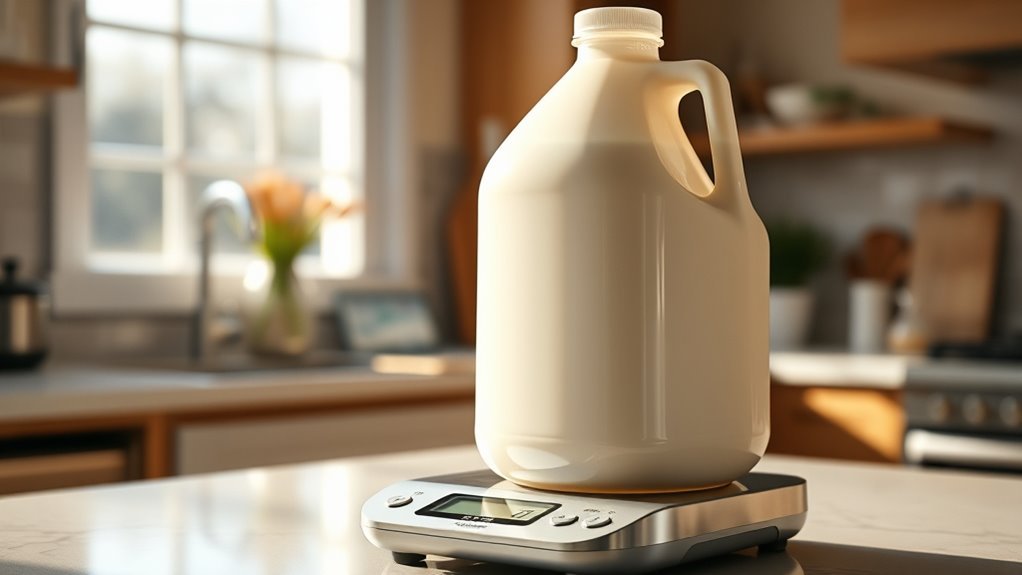
How Many Pounds Does a Gallon of Milk Weigh?
A gallon of milk typically weighs about 8.6 pounds, making it slightly heavier than water due to its fat and mineral content. The weight can vary depending on the type of milk—whole, skim, or cream—and its temperature.
Understanding how many pounds a gallon of milk weighs is useful for cooking, shipping, or managing inventory accurately. You might notice subtle differences in weight based on fat content and other factors.
If you want to learn more about how fat content, temperature, and additional elements affect milk’s weight, keep exploring for more details and practical tips.
Understanding the Difference Between Volume and Weight

Although you might use volume and weight interchangeably in everyday conversation, they measure different things. Volume tells you how much space something occupies, like the amount of liquid a container holds.
Weight, on the other hand, measures how heavy something is due to gravity pulling on its mass.
When you buy a gallon of milk, the “gallon” refers to volume, not weight.
So, a gallon represents a fixed amount of space the milk fills, but how much it weighs can change slightly depending on factors like temperature or milk composition.
Understanding this difference helps you grasp why a gallon of milk doesn’t always weigh the same as a gallon of water or other liquids, even though they occupy the same volume.
The Weight of a Gallon of Milk in Pounds

When you pick up a gallon of milk, you might wonder how much it actually weighs. Typically, a gallon of milk weighs about 8.6 pounds. This weight is slightly heavier than a gallon of water, which weighs exactly 8.34 pounds.
A gallon of milk weighs about 8.6 pounds, slightly heavier than water’s 8.34 pounds.
The difference comes from the milk’s components, fat, proteins, and minerals, which add density. So, when you carry that gallon jug, you’re handling more than just water.
Keep in mind, the weight stays fairly consistent across most types of milk you find in stores.
Understanding this helps when you’re measuring ingredients for recipes or managing groceries. Knowing the weight also aids in grasping nutrition facts and serving sizes more accurately, making it easier to plan your meals and track your intake.
Factors That Influence the Weight of Milk

Because milk contains various components like fat, protein, and minerals, its weight can fluctuate slightly depending on these factors. When you buy whole milk, it’s denser due to higher fat content compared to skim or low-fat milk, which weigh a bit less.
Temperature also plays a role; colder milk is denser, so it weighs more per gallon than warm milk.
Additionally, milk’s water content affects its weight. More water means lighter milk.
The source and processing methods can cause minor variations too. For example, milk from different breeds of cows or those with varying diets might’ve slightly different fat and protein levels, impacting weight.
Understanding these factors helps you grasp why a gallon of milk doesn’t always weigh exactly the same.
Comparing Milk Weight to Water Weight
The variations in milk’s weight due to fat content, temperature, and water levels become clearer when you compare it directly to water. You know a gallon of water weighs about 8.34 pounds at room temperature.
Milk, however, is denser because it contains fats, proteins, sugars, and minerals, making it weigh slightly more than water. For example, a gallon of whole milk typically weighs around 8.6 to 8.8 pounds, depending on its composition.
When you look at skim milk, which has less fat, its weight is closer to that of water, often just a bit heavier due to dissolved solids.
Understanding this comparison helps you grasp why milk’s weight isn’t constant. It’s tied to its unique makeup, unlike plain water.
How Milk Fat Content Affects Weight
Although you mightn’t realize it, milk’s fat content plays a key role in determining its weight. When you compare whole milk to skim milk, you’ll notice that whole milk weighs slightly less per gallon because fat is less dense than water.
Fat has fewer molecules packed into the same volume, so milk with higher fat content contains more fat but less water by volume. This means that a gallon of skim milk, which has nearly all water and minimal fat, weighs more than a gallon of whole milk.
If you choose cream or half-and-half, expect even lower weights per gallon due to their higher fat percentages.
Understanding this helps you accurately estimate weight for cooking, shipping, or nutritional purposes.
Converting Gallons to Pounds for Other Liquids
When you need to convert gallons to pounds for liquids other than milk, it helps to know their specific densities. Unlike milk, which averages about 8.6 pounds per gallon, other liquids vary widely in weight.
For example, water weighs roughly 8.34 pounds per gallon, while honey can weigh around 12 pounds per gallon due to its higher density.
To make the conversion, multiply the volume in gallons by the liquid’s density in pounds per gallon.
Keep in mind that temperature can affect density, so for precise calculations, use density values at a standard temperature, usually 68°F (20°C).
With this approach, you can accurately convert gallons to pounds for any liquid once you know its density.
Practical Uses for Knowing Milk’s Weight
Understanding how to convert gallons to pounds for various liquids can also help you appreciate why knowing milk’s weight matters in everyday situations. When you shop for milk, knowing its weight helps you estimate how much you can carry or store.
If you’re tracking your diet, understanding milk’s weight can assist in calculating nutritional intake accurately. It also helps when you’re cooking or baking since some recipes require ingredient weight conversions for precision.
Additionally, if you’re transporting milk in bulk, knowing the weight prevents overloading and ensures safety. Overall, having a clear idea of milk’s weight gives you better control whether you’re handling, measuring, or planning to use it efficiently in your daily routine.
Tips for Measuring Milk Accurately in Recipes
Since milk’s density can vary slightly depending on temperature and fat content, you’ll want to measure it carefully to guarantee your recipes turn out just right. Use a liquid measuring cup with clear markings, and measure on a flat surface at eye level to avoid errors. Pour slowly to the desired mark to prevent overfilling.
Here’s a quick reference to help you measure milk accurately:
| Measuring Tool | Best Practice |
|---|---|
| Liquid measuring cup | Use for volumes under 4 cups |
| Measuring spoons | Use for small quantities |
| Kitchen scale | Weigh for precise measurements |
| Eye level check | Avoids parallax errors |
Following these tips ensures your milk measurements are spot-on every time.
How Temperature Changes Impact Milk Weight
Measuring milk accurately is a great start, but you also need to contemplate how temperature affects its weight.
As milk warms up, it expands slightly, making a gallon weigh a bit less than when it’s cold.
Conversely, chilled milk contracts, so a gallon weighs a tad more when refrigerated.
While this difference isn’t huge, usually just a few ounces, it can matter if you need precise measurements for recipes or nutritional calculations.
Keep in mind that milk’s density decreases as temperature rises, so weighing it at room temperature versus straight from the fridge can yield slightly different results.
To get consistent measurements, try to measure milk at the same temperature each time or adjust your calculations to account for temperature changes.
Using Milk Weight for Shipping and Storage Calculations
When you plan to ship or store milk, knowing its weight helps you calculate shipping costs and storage requirements more accurately. Since a gallon of milk weighs about 8.6 pounds, you can estimate the total weight of your shipment by multiplying the number of gallons.
This precise weight calculation guarantees you don’t exceed carrier weight limits or underestimate shipping expenses. For storage, understanding milk’s weight helps you organize your refrigeration space efficiently, preventing overloading shelves or refrigerators.
Additionally, tracking milk weight assists in inventory management, making it easier to monitor supply levels and reorder on time.
Frequently Asked Questions
How Long Does Milk Stay Fresh After Opening?
You can keep milk fresh for about 5 to 7 days after opening if you store it properly in the fridge.
Make sure to seal the container tightly and avoid leaving it out at room temperature.
What Nutrients Are Found in a Gallon of Milk?
You’ll find calcium, protein, vitamin D, vitamin B12, potassium, and phosphorus in a gallon of milk. These nutrients support your bones, muscles, and overall health, making milk a nutritious choice for your diet.
Can Lactose-Intolerant People Drink Regular Milk?
You probably shouldn’t drink regular milk if you’re lactose intolerant because it contains lactose, which can cause discomfort.
Instead, try lactose-free milk or plant-based alternatives to avoid digestive issues while still enjoying your favorite drinks.
How Does Milk Spoil and What Are the Signs?
Like a knight’s sword rusting, milk spoils when bacteria multiply, breaking down lactose and proteins.
You’ll notice sour smell, curdling, and off taste.
If you see lumps or smell tangy, toss it out immediately.
What Are the Differences Between Whole and Skim Milk?
Whole milk has about 3.5% fat, making it creamier and richer, while skim milk has almost no fat, so it’s thinner and lower in calories.
You’ll notice a big taste and texture difference between them.
Conclusion
Now that you know a gallon of milk weighs about 8.6 pounds, it’s no coincidence that this knowledge helps in both the kitchen and shipping. You’ll find that understanding milk’s weight—affected by fat content and temperature—makes measuring and storing it much easier.
So next time you pour milk or calculate shipping costs, remember how this simple fact ties together everyday tasks with precision and care. Knowing how many pounds a gallon of milk weighs makes your efforts smoother and more accurate, whether for cooking or logistics.