How Long Does Breast Milk Last at Room Temperature? (Safe Storage Guide)
Think of breast milk as a delicate flower—its freshness can fade quickly when left out too long. If you’re wondering how long breast milk lasts at room temperature, you’re not alone. The answer isn’t as simple as a fixed number; various factors influence how long it stays good.
Keep this in mind as you consider the best way to handle and store expressed milk for your baby’s health. Proper storage helps preserve the milk’s nourishing qualities and ensures your little one gets the best nutrition possible.
Recommended Room Temperature for Breast Milk Storage

Although breast milk can stay safe at room temperature up to 77°F (25°C) for about 4 hours, you should use or refrigerate it within this time to guarantee quality. Proper temperature control is essential for breast milk safety, as warmer rooms or high humidity can shorten the safe storage time to 2-3 hours.
After expression, follow storage guidelines closely. Avoid leaving milk out beyond 6 hours, especially in warm or humid environments, to prevent early expiration.
Prompt refrigeration slows bacterial growth, preserving nutrients and freshness. When warming milk later, do so carefully to maintain safety.
Safe Time Limits for Breast Milk at Room Temperature

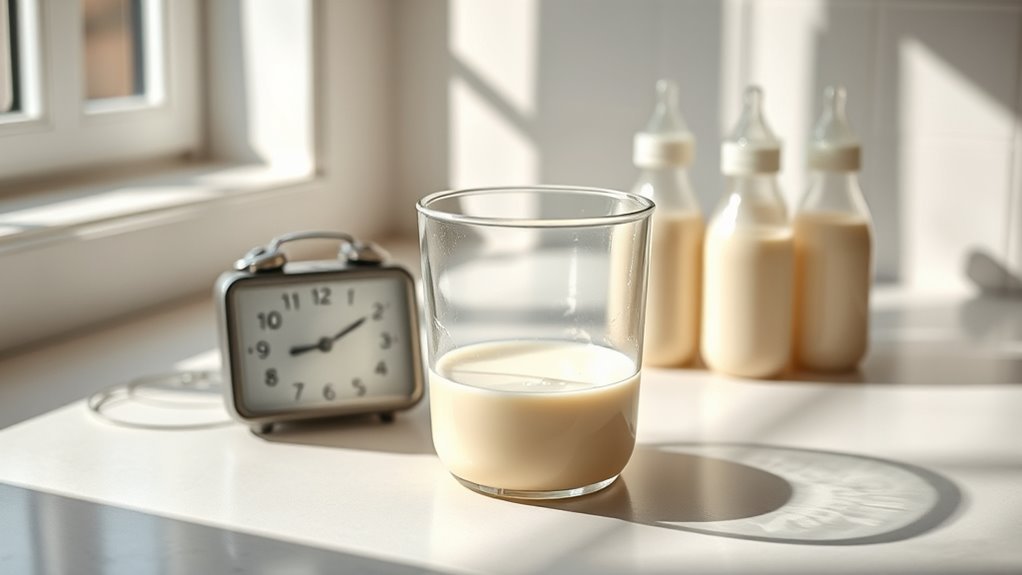
When you store breast milk at room temperature up to 77°F (25°C), you should use it within 4 hours to keep it safe for your baby. This storage time guarantees the milk remains free from harmful bacterial growth.
If the room feels warm or humid, aim to use the milk closer to 2 hours. Always keep breast milk covered in a clean container to maintain safety during handling.
After 4 hours at room temperature, discard any leftover milk to prevent risks to your infant. Following these storage guidelines helps you provide fresh, safe milk every time.
Proper temperature control and timely use are key to preserving breast milk’s quality and protecting your baby’s health.
Factors Affecting Breast Milk Shelf Life at Room Temperature

Knowing the safe time limits for storing breast milk at room temperature helps you use it properly, but several factors can influence how long it stays fresh. The shelf life of breast milk depends greatly on the room temperature and humidity; higher heat and moisture speed up bacteria growth, reducing storage time.
Clean handling during and after expression is vital to maintain safety and limit contamination.
Freshly expressed milk can last up to 6 hours in ideal conditions but refrigerating or freezing it within 4 hours is best to preserve quality and freshness.
Fresh breast milk stays safe up to 6 hours; refrigerate or freeze within 4 hours for best quality.
Always consider your environment’s temperature and humidity when storing milk, and prioritize refrigeration if you expect storage beyond 4 hours to guarantee safety and prevent spoilage.
Best Containers for Storing Breast Milk at Room Temperature
Selecting the right containers is essential to keep breast milk safe and fresh at room temperature. Use clean, food-grade containers like glass containers or BPA-free plastic storage bottles with tight-fitting lids.
Sterile, leak-proof storage bags designed specifically for breast milk are also suitable. Avoid household plastic bags or disposable liners, as they aren’t safe for storage. Always ensure your breast milk containers are thoroughly washed and dried before use to maintain clean storage.
Properly labeling breast milk with the date and time of expression helps keep track of freshness.
| Container Type | Key Features |
|---|---|
| Glass Containers | Food-grade, easy to sterilize |
| BPA-free Plastic Bottles | Leak-proof, reusable |
| Sterile Storage Bags | Leak-proof, designed for milk |
Tips for Handling Expressed Breast Milk Safely
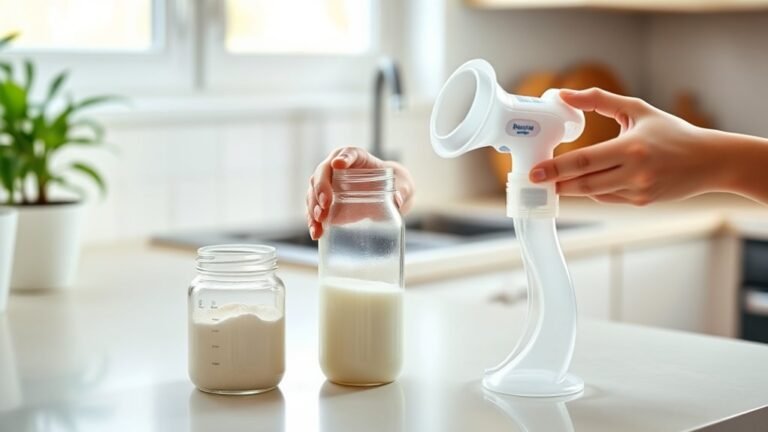
Because breast milk can easily become contaminated, you should always wash your hands thoroughly before handling it.
Always wash your hands thoroughly before handling breast milk to prevent contamination.
Use clean storage containers or special milk storage bags with proper container sealing to keep milk safe.
Label each container with the date and time to help with milk rotation, using the oldest milk first.
Keep breast milk at room temperature (77°F or colder) for no longer than 4 hours to minimize bacterial growth.
Avoid leaving milk out too long, especially in warm or humid conditions, to prevent bacterial contamination.
- Wash your hands before every milk handling session
- Use sealed, clean containers designed for breast milk
- Label containers clearly with expression date and time
- Store milk promptly in refrigeration or freezing after use or 4 hours at room temperature
How to Store Breast Milk When Refrigeration Is Not Available
When refrigeration isn’t an option, you can still keep breast milk safe by storing it properly at room temperature or using a cooler bag with ice packs.
For breast milk storage at room temperature (up to 77°F), freshly expressed milk is best used within 2 to 4 hours to ensure infant safety.
If the environment is cooler and hygienic, storage time may extend up to 6 hours. Always use clean containers, seal them tightly, and keep milk away from direct sunlight or heat to maintain quality.
To extend expiration time, use an insulated cooler bag with ice packs, which can safely hold milk up to 24 hours. Following these storage guidelines helps keep breast milk fresh and safe when you can’t refrigerate.
Signs That Breast Milk Has Spoiled at Room Temperature
Proper storage helps keep breast milk safe, but it’s just as important to recognize when it’s no longer good to use. Spoiled breast milk at room temperature often shows clear signs that you shouldn’t ignore.
Before feeding, check for any off odor or sour smell, which can signal spoilage. Look closely for a change in color—milk turning yellow or brown is a red flag. Texture changes, like a slimy or clumpy appearance, mean the milk has gone bad. Don’t taste suspicious milk, but if it has a rancid taste, discard it immediately.
Watch for these signs of spoiled breast milk:
- Sour smell or off odor
- Change in color to yellow or brown
- Slimy or clumpy appearance
- Noticeable texture change or separation
Combining Fresh and Stored Breast Milk Safely
Although combining fresh and stored breast milk can be convenient, you need to handle it carefully to keep the milk safe and nutritious. Always cool fresh breast milk to refrigeration temperature before adding it to stored breast milk. Avoid mixing warm milk with refrigerated or frozen milk to prevent bacterial growth and partial thawing.
When combining milk, mix gently and label the container with the oldest milk’s date. Follow storage guidelines strictly: use combined milk within 24 hours under refrigeration or 1–2 hours at room temperature.
| Step | Action | Reason |
|---|---|---|
| 1 | Cool fresh milk | Prevent bacterial growth |
| 2 | Add to stored milk | Maintain temperature control |
| 3 | Mix gently | Preserve nutrients, avoid contamination |
| 4 | Label container | Ensure milk safety and timeline |
Frequently Asked Questions
What Happens to Breast Milk After 4 Hours?
After 4 hours, breast milk starts to spoil and harmful bacteria can multiply, making it unsafe for your baby. You shouldn’t feed your baby milk left out longer than that to avoid health risks.
What Is the 4 4 4 Rule for Breast Milk?
Think of the 4-4-4 rule as your breastfeeding compass: you can keep milk 4 hours at room temp, 4 days refrigerated, and 4 months frozen. It guides you to keep milk fresh and safe for your baby.
What Is the 2 Hour Rule for Breast Milk?
The 2-hour rule means you should use or refrigerate freshly expressed breast milk within two hours at room temperature.
If it’s warmer than 77°F, you’ve got only one hour before you need to act.
How Long Can Pumped Breast Milk Sit at Room Temperature?
You can leave pumped breast milk at room temperature for up to 4 hours if it’s below 77°F.
If it’s warmer, use or refrigerate it within 2 hours to keep it safe and fresh.
Conclusion
You should know that breast milk stays safe at room temperature (up to 77°F) for about 4 hours, but in warmer or more humid conditions, that drops to just 2-3 hours. This means you need to be extra careful when storing and handling it to protect your baby.
Remember, using or refrigerating milk within this window helps keep it fresh and safe. So don’t take chances with leftovers after 4 hours—they can harbor harmful bacteria.
To ensure the best for your baby, always follow these guidelines on how long breast milk lasts at room temp. Proper storage and timely use are key to maintaining its quality and safety.